Tuesday, February 28, 2006

Paul Arden's switched publishers, from Phaidon to Penguin for his new book: Whatever You Think, Think The Opposite.

Known for art and photography books, Phaidon's book designs tend to be better and more slick. That was part of the appeal of his first book It's Not How Good You Are, It's How Good You Want To Be.

That book is great for raising downtrodden spirits, and I picked up the second based on the strength of the first. Yes, even though Penguin chose to publish the covers in unfinished heavy paper, which looks dull and stains easily. The paper used in the book also smells awful, and the book's a lot more expensive than his first one.

Once you get past the physical flaws, Whatever You Think has an even stronger rah-rah effect than its predecessor, part of which is probably because it's a more internally consistent work. I thought one of the (very) minor flaws of It's Not How Good You Are was that the little snippets that comprise the book were a bit disjointed, ranging from abstract inspirational bites to tidbits of practical advertising advice. The stories in Whatever You Think have a more evenly irreverent, defiant tone.

Sunday, February 26, 2006

My life is turning into a Woody Allen movie, one of his earlier ones. If only I could be as prolific as he.

Monday, February 20, 2006

New Murakami Haruki short story in the New Yorker: A Shinagawa Monkey

Monday, February 13, 2006

The Museum Shop has a line of coasters based on the old Early Ship series of stamps issued here in 1980. These stamps were a ubiquitous sight on almost all mail during the 80's, particularly the Fujian Junk one (15c) because that was how much it cost to send a standard letter back then.

The coasters are simple: the stamp design enlarged and printed on a plain white tile, with a sheet of cork stuck on the bottom. At $5 a piece, they're affordable.

I've always thought the designs were very appealing. Clean, crisp line drawings with minimal colouring and Helvetica typeface. The photo taken with my dinky Palm doesn't do it justice at all.

The Banyan Tree should consider selling a set of coasters containing each stamp from the Ship series.

Thursday, January 26, 2006

It seems to me that once you ask why you need an iBook or an iPod, you never really wanted one in the first place.

Monday, January 23, 2006

I didn't feel excited when I got my new iPod last night. It was more like relief; relief at not having to think about getting an iPod anymore. Being able to listen to music all the time again is bliss. Why did I put it off for so long?

Monday, January 16, 2006

Great. Now no-one will come back.

ChannelNewsAsia.com - Government to impose stiffer penalties for NS defaulters

Melvyn Tan was in his 50s, and he risked the wrath of the authorities to come back and see his sick parents. I wonder how many of those who complained can boast such filial piety?

Speaking of hypocrisy, isn't hiding the truth a sin in Christianity?

ChannelNewsAsia.com - Non-profit group gets grant to promote 'healthy gender identity'

Tuesday, January 10, 2006

The return of political consciousness to American film?

Guardian Unlimited Film | Features | Hollywood's new politics

Founding eBay made Jeff Skoll a billionaire. Now he is doing something very different - producing political movies that recall the rabble-rousing days of Warren Beatty and Robert Redford, and turning American filmgoers into grassroots activists

Sunday, January 08, 2006

On reading today's Sunday Times feature on the foam spray menace, I was disturbed at the readiness of Singaporeans to attribute sexual rapaciousness to foreign workers (presumably Indian or Bangladeshi construction workers). Consider:
Though victims largely point the finger at foreign workers, police said the eight arrested were a mix of locals and foreigners.

and:
Marketing manager Teo Shuyin, 21, who was on Orchard Road last Saturday, recalls walking with her arms folded across her chest. She said the culprits were foreign workers.

'They set on us the moment we stepped out of the car. I was hiding behind people and using my arms to cover my chest. And even when they weren't spraying, you could feel them staring at you,' she said.

Of course molestation is wrong, but how can Singaporeans be so sure that the culprits aren't locals?

Saturday, January 07, 2006

Reviews of Reiner Stach's Kafka: The Decisive Years. This one's from the NYT, and this one's from Michael Dirda, resident book critic at the Washington Post. On the whole, Dirda's is more positive, but he spends more of the review being wistful about Kafka than actually commenting on the book itself.
Tash Aw's novel The Harmony Silk Factory, shortlisted earlier for the Man Booker Prize, cliched the 2005 Whitbread First Novel Award. I'm glad to see that a Southeast Asian author has been recognised overseas, but slightly ashamed that no Singaporean writer has even gotten half as far as Aw in the literary world. Hwee Hwee Tan got published, and umm... that's about it. Surely we can do better?

Tuesday, January 03, 2006

Housekeeping for the new year.

Friday, December 30, 2005

William Taubman spent 20 years researching Khrushchev: The Man and His Era. It seems a marvel to me how all that effort, sustained over so many years, now weighs so lightly on my hands!

Taubman is clearly an unsympathetic biographer. He gives his subject credit where it's due, but doesn't hesitate to be critical where necessary (which is most of the time). It's clear that Khrushchev was no moral exemplar, no great strategist or thinker -- not even a good father. As a national leader, he was a blunderer. The more he tried to show how capable or strong he was, the less people thought of him.

Sunday, December 18, 2005

I was very disappointed by Peter Kuper's comic adaptation of Franz Kafka's The Metamorphosis. I don't have a problem with the style, resembling caricaturish woodcut prints, but the art and overall treatment is flippant. Kuper doesn't seem to have bothered capturing any deeper meaning behind Gregor's horror, choosing instead to let his own cleverness run riot. For instance, on one page the text follows Gregor haphazardly around the page, mirroring his ascent up the wall.

To cap it all off, Kuper thanks Kafka for being "kind enough to put pen to paper in the first place", as if Kafka's tortured work came from some kind of charity dinner altruism. Oh, we'd like to thank Mr. So-and-So who was kind enough to donate a halibut. Infuriating.

Tuesday, December 06, 2005

"I almost think that if I'd gotten the Nobel Prize when The Recognitions was published I wouldn't have been terribly surprised," Gaddis told The Paris Review in 1986, adding that the book's reception had been "sobering" and "humbling." Maybe if the novel had met with greater acclaim Gaddis would have relaxed a little; maybe Wyatt's "what is it they want" tirade, like his other puritanisms, would have been revealed as a skinny-young-man attitude to be outgrown. I doubt it, though. The book is about the everyday world's indifference to the superior reality of art. Its last line ("with high regard, though seldom played") unmistakably prefigure its own reception. Nurturing the hope that your marginal novel will be celebrated by the mainstream - the Cassandra-like wish that people will thank you for telling them unwelcome truths - is a ritual way of ensuring disappointment, of reaffirming your own world-denying status, of mortifying the flesh, of remaining, at heart, an angry young man. In the four decades following the publication of The Recognitions, Gaddis's work grew angrier and angrier. It's a signature paradox of literary postmodernism: the writer whose least angry work was written first.

--- Jonathan Franzen, "Mr Difficult" in How To Be Alone

Wednesday, November 30, 2005

It's all too easy, therefore, to forget how frequently good artists throughout the ages have insisted, as Auden put it, that "art makes nothing happen." It's all too easy to jump from the knowledge that the novel can have agency to the conviction that it must have agency. Nabokov pretty well summed up the political platform that every novelist can endorse: no censorship, good universal education, no portraits of heads of state larger than a postage stamp. If we go any further than that, our agendas begin to diverge radically. What emerges as the belief that unifies us is not that a novel can change anything but that it can preserve something. The thing being preserved depends on the writer; it may be as private as "My Interesting Childhood." But as the country grows ever more distracted and mesmerized by mass culture, the stakes rise even for authors whose primary ambition is to land a teaching job. Whether they think about it or not, novelists are preserving a tradition of precise, expressive language; a habit of looking past surfaces into interiors; maybe an understanding of private experience and public context as distinct but interpenetrating; maybe mystery, maybe manners. Above all, they are preserving a community of readers and writers, and the way in which members of this community recognize each other is that nothing in the world seems simple to them.

--- Jonathan Franzen, "Why Bother?" in How To Be Alone

Tuesday, November 29, 2005

A nation which ignores and does not encourage its theatre is, if not culturally dead, culturally pitiable; just as the theatre which ignores the drama of its people, and fails to register their trials as well as their triumphs, their tears and their laughter, has little right to call itself a national theatre, but merely as amusement hall, a place for those who attend merely to "kill time".

-- Goh Poh Seng

Tuesday, November 15, 2005

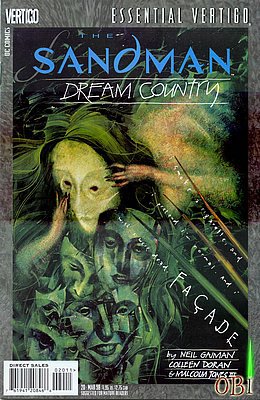
When the first living thing existed, I was there waiting. When the last living thing dies, my job will be finished. I'll put the chairs on the table, turn out the lights and lock the universe behind me when I leave.

--- Neil Gaiman
"Dream Country: Fa�ade"
Sandman #20

Monday, November 14, 2005

Things need not have happened to be true. Tales and dreams are the shadow-truths that will endure when mere facts are dust and ashes, and forgot.

--- Neil Gaiman
"Dream Country: A Midsummer Night's Dream"
Sandman #19

Saturday, November 05, 2005

Lvov: Why have you brought me to this house of reptiles? This is not a place where honest people should be seen.

Anna: Would you mind, Doctor, can I give you a social tip? It's bad manners to take a lady out and keep on about how honest you are. Perhaps it's true but nobody wants to know. I promise you, it's good advice. Don't draw attention to your virtues. Let women discover them for themselves. When Nikolai was your age, then he did nothing but sing songs and tell stories. And there wasn't one woman alive who couldn't sense what a fine man he was.

Lvov: Please. Don't compare me with Nikolai. I know everything about him.

Anna: No. You don't. You're a good man but you know nothing. Let's go into the garden. Nikolai never used to rail against the menagerie. You never heard Nikolai call people reptiles. Or boast about his own superiority. He left people alone to live their own lives. If he spoke at all it was to blame himself for his own impatience, or to express his pity for some poor soul. That's how he was. Forgiving. Not like you...

--- Anton Chekov, Ivanov, Act 2 Sc 10. Adapted by David Hare.