I got an iMac over the weekend.
And yes, I've already pressed the F9 button on my work (Windows) laptop more than a few times today.
Monday, December 18, 2006
'Be short, be simple, be human'
All entrants into the service come equipped with a vocabulary of common words of precise meaning adequate for all ordinary purposes. But when they begin to write as officials they have a queer trick of forgetting them and relying mainly on a smaller vocabulary of less common words with a less precise meaning.--- Gowers, The Complete Plain Words (3rd Edition)
Picked this up over the weekend at Kinokuniya Bargain Alley. It's a bit battered, but a book like this wants to be worn out. Incidentally, it's a Penguin Reference edition. Simple yet striking design: the horizontal grid reminiscent of early Penguins, the distinctive rounded corners, and sleek Futura.
Kaliya Mardan
Kudos to the National Museum for bringing in the 1919 silent Indian film Kaliya Mardan for a screening as part of its opening celebrations this month. Apparently the most extant work of D.G. Phalke (according to the NYT). I hope the Cinematheque (the ostentatious name for the film programme there) will continue bringing in such works -- manna to film buffs and academics!
This was a rare glimpse into what film was like when it was new. When all the conventions that modern audiences are used to hadn't been invented yet. We're so used to movies now that it's difficult to imagine the fear and excitement that cinema once elicited. "Movie magic" has become such a cliche now, but it really was magic once.
What it was like when the world was new?
The screening was preceded by a documentary of D.G. Phalke's life and work, with snippets of him at work and bits from his films. What impressed me the most was the ingenuity involved in creating the special effects. I'm so jaded by CGI that camera tricks look charming in comparison. You knew that the people involved only had camera, film stock and their imaginations to work with. They all basically experimented with multiple exposures instead of manipulating vectors on a computer screen.
The other fascinating thing was that films were shot for audience participation -- hardly the rarefied objects they've since become. For instance, every shot was pretty much at waist-level and the actors keep glancing at the audience. Some of the latter was probably due to inexperience, but somehow there is a charming lack of self-consciousness throughout the film. It feels like you're there in the film with the actors. Intentional or not, this fit in very nicely with religious aspect of "mythologicals" -- audiences would chant and sing to commemorate the deity on screen. Audiences were expected to make noise. Contrast that to present ideas about filmmaking, where filmmakers try to build a hermetic, self-enclosed world and the audience is detached, elsewhere, watching like gods.
This was a rare glimpse into what film was like when it was new. When all the conventions that modern audiences are used to hadn't been invented yet. We're so used to movies now that it's difficult to imagine the fear and excitement that cinema once elicited. "Movie magic" has become such a cliche now, but it really was magic once.
What it was like when the world was new?
The screening was preceded by a documentary of D.G. Phalke's life and work, with snippets of him at work and bits from his films. What impressed me the most was the ingenuity involved in creating the special effects. I'm so jaded by CGI that camera tricks look charming in comparison. You knew that the people involved only had camera, film stock and their imaginations to work with. They all basically experimented with multiple exposures instead of manipulating vectors on a computer screen.
The other fascinating thing was that films were shot for audience participation -- hardly the rarefied objects they've since become. For instance, every shot was pretty much at waist-level and the actors keep glancing at the audience. Some of the latter was probably due to inexperience, but somehow there is a charming lack of self-consciousness throughout the film. It feels like you're there in the film with the actors. Intentional or not, this fit in very nicely with religious aspect of "mythologicals" -- audiences would chant and sing to commemorate the deity on screen. Audiences were expected to make noise. Contrast that to present ideas about filmmaking, where filmmakers try to build a hermetic, self-enclosed world and the audience is detached, elsewhere, watching like gods.
Thursday, December 14, 2006
On "Credibility"
Many Singaporeans online appear to think that all opinions should be equally respected so long as they come from individuals. This is silly, because the right to say what you want is not the same as being credible or correct.
The Straits Times used to derive a lot of its credibility, in the eyes of most Singaporeans, from the fact that it was a government mouthpiece. So the paper's reputation was tied to how well people thought of the government.
Now, some Singaporeans appear to be ascribing credibility to sites that are not the Straits Times (especially blogs), simply because these sites are not the ST. My guess is that this is a knee-jerk reaction against The Straits Times' pro-government stance; a reaction fuelled in part by grievances against the government.
But fundamentally nothing much has changed. Many Singaporeans still define the "credibility" of a source by its distance from the government. Whatever happened to thinking critically? Non-ST sources need to be questioned too.
Also see Seah Chiang Nee's article on the "credibility gap" between bloggers and the offical media. Akikonomu has a response.
The Straits Times used to derive a lot of its credibility, in the eyes of most Singaporeans, from the fact that it was a government mouthpiece. So the paper's reputation was tied to how well people thought of the government.
Now, some Singaporeans appear to be ascribing credibility to sites that are not the Straits Times (especially blogs), simply because these sites are not the ST. My guess is that this is a knee-jerk reaction against The Straits Times' pro-government stance; a reaction fuelled in part by grievances against the government.
But fundamentally nothing much has changed. Many Singaporeans still define the "credibility" of a source by its distance from the government. Whatever happened to thinking critically? Non-ST sources need to be questioned too.
Also see Seah Chiang Nee's article on the "credibility gap" between bloggers and the offical media. Akikonomu has a response.
Monday, December 11, 2006
Yet another S'pore film site? sgNewWave
Students from Ngee Ann Polytechnic's School of Film and Media Studies have set up their own film commentary site, ambitiously called sgNewWave (http://www.sgnewwave.com/). Moreover, they apparently want to make this the Singapore equivalent of Cahiers du Cinema.
Well, we'll see.
I like how their masthead is a nod to Sight & Sound, but did they really have to use Impact?
(From sinema.sg)
Well, we'll see.
I like how their masthead is a nod to Sight & Sound, but did they really have to use Impact?
(From sinema.sg)
Thursday, December 07, 2006
Sight and Sound
Directors, scripts and actors are important, but film is fundamentally an experience of sight and sound. Two recent articles from The Guardian:
One on music in films. The writer criticises Woody Allen's exploitative use of Gershwin in Manhattan.
The second examines Michael Mann's obsession with architecture and design:
Articles:
Manhattan music mystery
Star Vehicles
One on music in films. The writer criticises Woody Allen's exploitative use of Gershwin in Manhattan.
Because Gershwin's music had already been enshrined in the cultural pantheon for decades, its use in Manhattan seems like an extraordinarily cunning trick, like citing Descartes in a school report and acting like you and René were old drinking buddies. Gershwin is not being recruited here merely to provide ambiance; Gershwin, with assistance from the great cinematographer Gordon Wills, is on hand to evoke the emotions that Allen's screenplay and characters cannot.
The second examines Michael Mann's obsession with architecture and design:
Manhunter is set in Atlanta. White tiles and neat Swiss typography establish the police station as a place of authority, but equally the whiteness and geometry of Lecter's cell is a diagram of depravity, a frame for deadly menace. Meanwhile, over in the serial killer's apartment, there are modernist Alvar Aalto stacking tables, nicely suggestive of tidy-paws preoccupations. A white version of Richard Sapper's low-voltage Tizio desk light coruscates in one scene, next to an old-generation white Bell telephone with a lasciviously curly flex. Everywhere Mann uses architecture to express a psychiatric state.
Articles:
Manhattan music mystery
Star Vehicles
Wednesday, December 06, 2006
The cutest hellhound ever
 Yes, there are stuffed toy versions. I've seen one in person and it's devilishly cute. Wonder where I can get one here?
Go visit Cerbi.
Stats for cocktail parties
BBC NEWS | Business | Richest 2% own 'half the wealth'
The richest 2% of adults in the world own more than half of all household wealth, according to a new study by a United Nations research institute.
The report, from the World Institute for Development Economics Research at the UN University, says that the poorer half of the world's population own barely 1% of global wealth.
Tuesday, December 05, 2006
She either loves him very much...
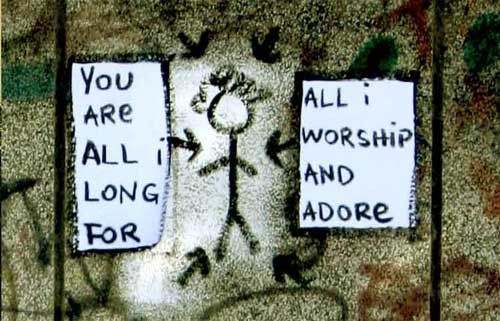 ... or has too much time on her hands. A boy wakes up to find a map of locations along the route he takes to school, where his girlfriend has illustrated lines from "Fly Me to the Moon". It's really sweet; she's a keeper. Lucky bastard.
See the rest of the street art here. Thanks to Wooster Collective!

Saturday, December 02, 2006
Friday, December 01, 2006
Monday, November 27, 2006
BooksActually celebrates its 1st birthday
As the email says:
BooksActually is at 125A Telok Ayer Street. Look for the whitewashed horse kiddy-ride machine.
Do come for our 1st Anniversary Party on 29th November, Wednesday, from 12 noon till 9 pm for a whole lot of waffles, films, cupcakes, tea, ribboned balloons, Italian notebooks named "Ciak", root beer & ginger beer goodness!
BooksActually is at 125A Telok Ayer Street. Look for the whitewashed horse kiddy-ride machine.
Pocky x Gundam

Further confirming Pocky as the otaku snack of choice (well, outside Japan), Glico teamed up with Bandai to offer... Pocky Gunpla Packs. Yeah, those little plastic things kinda suck but it's the concept man, the concept! Available for a limited time only.
(From Gunota Headlines)
Friday, November 24, 2006
My Penguin
Penguin's released a new series of classic works with blank covers. The main selling point of the "My Penguin" series is -- you guessed it -- that you get to design your own cover.
You can send yourscrawlings unique cover art in to Penguin, and they'll showcase the best (which is also a good way to drive traffic to your website).
Clever. But will these books be cheaper since there's no cover art? Part of the appeal of buying a book for me lies in the book design -- buying books is a sensual activity for me. I like to observe feel smell books (which is why I hate it when bookshops shrink-wrap) -- I'm not going to pay more for a blank cover if I can get something more aesthetically pleasing for the same price.
The Penguin Blog: YourSpace
You can send your
Clever. But will these books be cheaper since there's no cover art? Part of the appeal of buying a book for me lies in the book design -- buying books is a sensual activity for me. I like to observe feel smell books (which is why I hate it when bookshops shrink-wrap) -- I'm not going to pay more for a blank cover if I can get something more aesthetically pleasing for the same price.
The Penguin Blog: YourSpace
Robert Pirsig Interview
The author of Zen and the Art of Motorcycle Maintenance and Lila grants a rare interview.
The interview: Robert Pirsig | Review | The Observer
'Well,' he says, 'there was fear. All these ideas were coming in to me too fast. There are crackpots with crazy ideas all over the world, and what evidence was I giving that I was not one of them?'
The interview: Robert Pirsig | Review | The Observer
Thursday, November 23, 2006
I love Paprika!

Satoshi Kon excels at mindblowing visual tricks, which makes him an interesting director for animated psycho-thrillers, as shown in his debut Perfect Blue. Paprika seems to belong to the same genre, but has more in common with Millennium Actress (Sennen Jouyu) in its exploration of reality-fantasy blurring and the more fantastic tone. Cast comprising well-known seiyuus led by Megumi Hayashibara. The opening theme is an exuberant earworm, and playful film references abound.
Official site
You can play a game on the homepage where you have to search for the DC Mini. Finding it will allow you access to the radioclub.jp site (if you go directly there you'll get a mock error page) which has minigames and quizzes. Playing further will eventually unlock a gallery with 6 wallpapers. Fairly boring stuff though -- just stills from the film.
Be warned -- playing the game on the site gives away the plot entirely. (Then again, it *is* based on a novel...)
Image Gallery from the official blog
Composer Susumu Hirasawa's website with free mp3s
And it hasn't seen a general release in Japan yet!
Wednesday, November 22, 2006
The things we do for love
The NYT has a brief article about the counterintuitive personal ads that run in the London Review of Books:
I thought my personal ad would look more like the Pina Colada Song. Maybe I need something edgier.
The New York Times: Book Lovers Seek Lovers, Buttered or Plain
But in the strange alternate universe that is the personals column in the London Review of Books, a fetish for even the naughtiest dairy product is considered a perfectly reasonable basis for a relationship. Rejecting the earnest self-promotion of most personal ads, the correspondents in the London Review column tend instead to present themselves as idiosyncratic, even actively repellent.
I thought my personal ad would look more like the Pina Colada Song. Maybe I need something edgier.
The New York Times: Book Lovers Seek Lovers, Buttered or Plain
The Great Singapore Biennale Sale
UPDATE: The sale of collectibles etc ended on 23/11. You can still get badges though.

28 31 down, 67 64 more to go :p
There's a lot of leftover merchandise from the Singapore Biennale, and it's selling at a mad 70% discount. I got a Barbara Kruger t-shirt at just $6 (If you'd gotten it during the Biennale, you'd have shelled out $20).
(Browse the merchandise here)
There're also tonnes of free badges left over from the contest (free badges were available at each Biennale venue, and if you managed to collect all 95 designs you could've won some Pioneer loot).
Just head over to the Biennale office on the 5th floor of The Adelphi, open Mondays to Fridays, 10am to 6pm. Bring cash.

There's a lot of leftover merchandise from the Singapore Biennale, and it's selling at a mad 70% discount. I got a Barbara Kruger t-shirt at just $6 (If you'd gotten it during the Biennale, you'd have shelled out $20).
(Browse the merchandise here)
There're also tonnes of free badges left over from the contest (free badges were available at each Biennale venue, and if you managed to collect all 95 designs you could've won some Pioneer loot).
Just head over to the Biennale office on the 5th floor of The Adelphi, open Mondays to Fridays, 10am to 6pm. Bring cash.
Subscribe to:
Posts (Atom)